
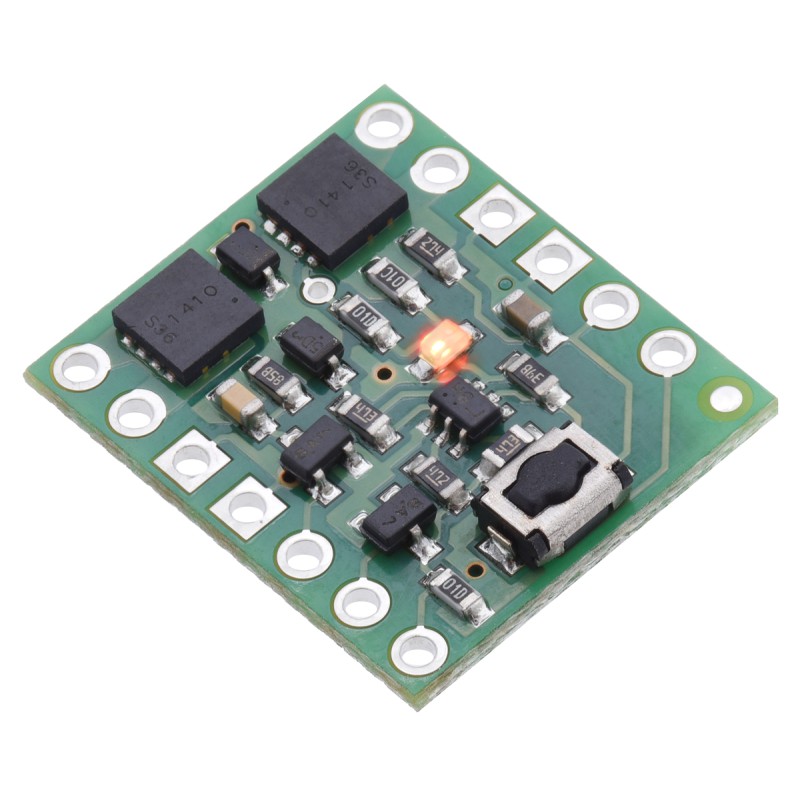
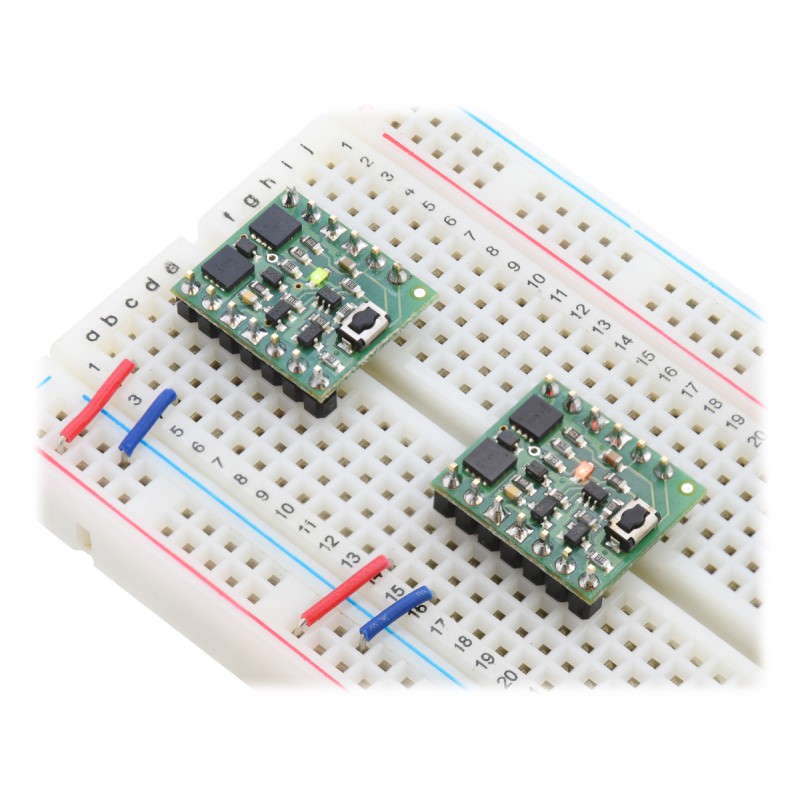
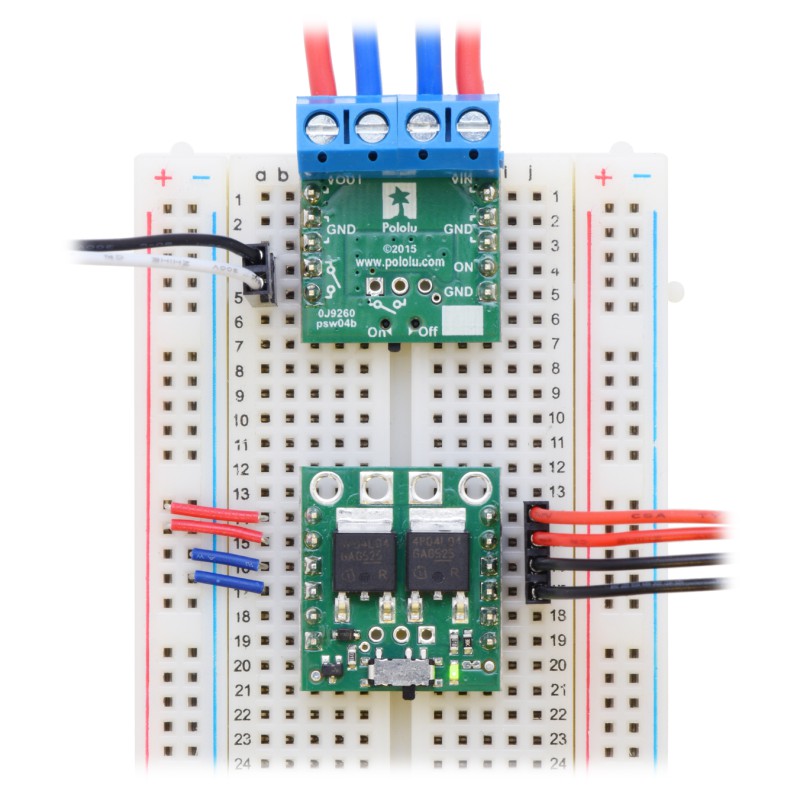
The Pololu Pushbutton Power Switch is a compact, solid-state power switch that features built-in reverse-voltage protection and is controlled by a momentary pushbutton: one push turns on power and another push turns it off. This is a patented design initially created for use in our own products as an alternative to bulky mechanical switches. Because the switched current does not flow through the mechanical switch, a large variety of small, low-power switches can be used to control a substantial amount of power. The use of momentary switches also allows multiple switches to be used in parallel to control the power to one load.
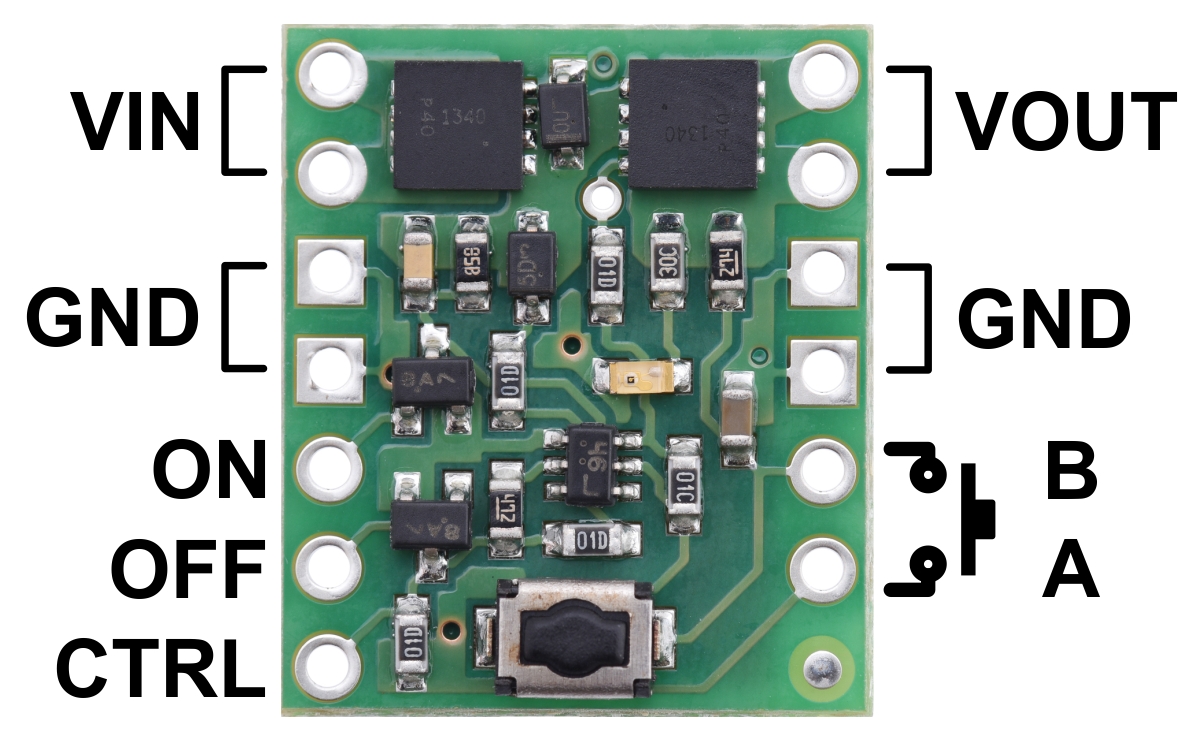
The board has a small pushbutton already installed and offers convenient points for connecting external pushbutton or tactile switches in parallel. It also offers several alternate pushbutton connection options that result in push-on-only or push-off-only operation, and additional inputs enable further power control options like allowing the load to turn off its own power, which can be beneficial when used with battery chemistries sensitive to over-discharging.
The two Mini Pushbutton Power Switches are smaller, lower-current versions that are useful for applications with tight size constraints or lower power requirements. Also, the the Mini LV is the only one of the four that works below 4.5 V; since it can operate down to 2.2 V, this version can be used with a single lithium cell battery.
Benefits and limitations
The Pololu Pushbutton Power Switch works well in its intended application as a DC power switch for small robots, but because it is fundamentally different from a mechanical power switch, the benefits and drawbacks of the components must be fully considered.
Benefits over mechanical switches:
- Compact size
- Reverse-voltage protection
- Allows multiple (parallel) switches for improved user interface
- Better turn-on characteristics than a bouncing mechanical switch
- Limited LC spikes for low-resistance loads
- Allows self-shutoff (OFF input)
- Allows external digital device to control the power state (ON and CTRL inputs)
- Breadboard and perfboard compatible (0.1″-pitch)
Drawbacks compared to mechanical switches:
- Switch is one-directional (power applied to VOUT cannot be switched to VIN)
- Limited operating voltage range
- Switch can lose its state when power is disconnected (the switch typically defaults to being off when power is first applied, but it can default to being on near the upper end of the operating range)
- Switches DC only (does not maintain state through power disruptions or excessive noise)
- No complete isolation in off state
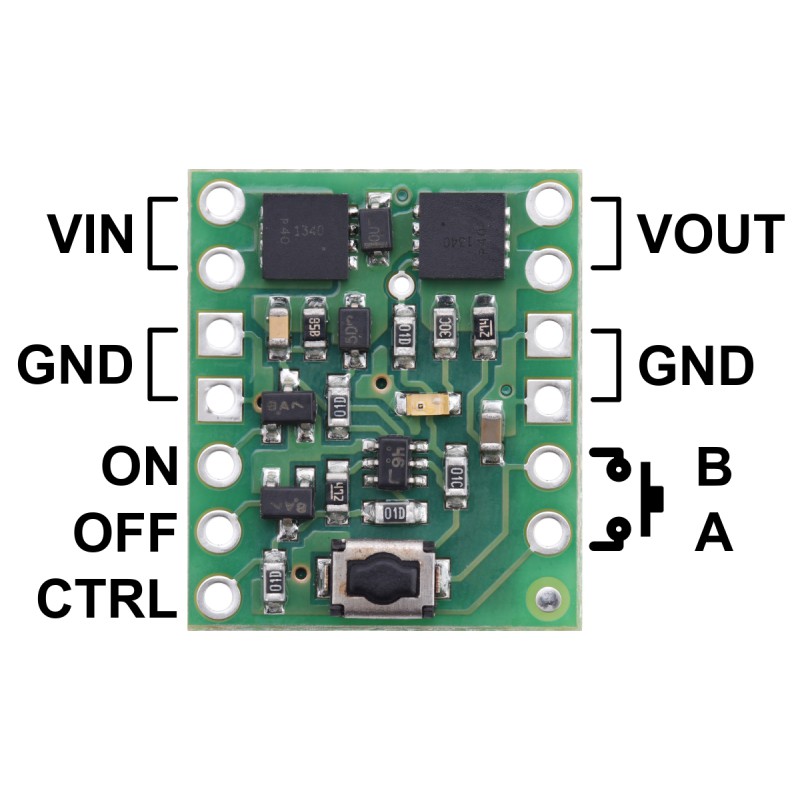
| PIN | Description |
|---|---|
| A | Connect through momentary switch to pin “B” for standard push-on/push-off operation. Connect through momentary switch to ground for on-only operation. |
| B | Connect through momentary switch to pin “A” for standard push-on/push-off operation. |
| ON | A high pulse (> 1 V) on this pin turns on the switch. |
| OFF | A high pulse (> 1 V) on this pin turns off the switch (e.g. allowing the target device to shut off its own power). |
| CTRL |
This pin directly determines the state of the switch. A high pulse (> 1 V) on this pin turns on the switch; a low pulse (e.g. driving the pin low with a microcontroller output line or pushing a button connected from this pin to ground) turns the switch off. Leave this pin disconnected or floating when not trying to set the switch state. Note that this pin should not be driven high at the same time the “OFF” pin is driven high. |
Dimensions
| Size: | 0.6″ × 0.7″ × 0.12″1 |
|---|---|
| Weight: | 0.6 g1 |
General specifications
| Current rating: | 6 A2 |
|---|---|
| Minimum operating voltage: | 2.2 V |
| Maximum operating voltage: | 20 V3 |
| Reverse voltage protection?: | Y |
Identifying markings
| PCB dev codes: | psw03a, psw03c |
|---|---|
| Other PCB markings: | 0J9124 |
| LED color: | red |